Your knees creak when you stand up from the couch. Your shoulders ache after a workout that used to feel nothing. Every morning, you look in the bathroom mirror and roll your stiff back like you’re trying to shake something loose.
You are stretching more, warming up longer, icing more often — and the soreness still lingers.
Your doctor says it is just part of getting older. Maybe they prescribed ibuprofen or suggested you scale back. But you are 42, not 72, and “slow down” is not a treatment plan. It is surrender.
I know this feeling well. A few years ago I was in that exact spot — buying every joint supplement on the shelf and wondering why nothing stuck. Then I started looking at what actually changes in our bodies after 40, and the answer turned out to be far more specific than “aging.”
What’s Actually Happening in Your Body After 40
The joint pain you are feeling is not random. It is several biological processes speeding up at once:
Inflammation rises. Chronic low-grade inflammation goes up as immune regulation declines. This creates a baseline inflammatory state in joints, tendons, and connective tissue that was not there in your 30s. You are not just inflamed from a workout — you are inflamed at rest.
Growth hormone drops fast. GH is critical for tissue repair, collagen production, and recovery. It declines approximately 14 percent per decade from age 30. By 45, you are producing roughly half the GH you had at 25. Your recovery is slower because the repair signal is weaker.
Collagen production slows down. Cartilage, tendons, and ligaments are collagen-based structures. Less collagen means less structural repair, thinner cartilage, and weaker connective tissue. Women lose it even faster after menopause.
Hormone levels shift. Testosterone supports muscle mass, bone density, and tissue repair in both men and women. As levels decline, muscles weaken, bones thin, and the supportive structures around joints lose integrity.
Gut health deteriorates. The gut lining weakens with age, stress, and diet changes. Increased intestinal permeability lets inflammatory molecules into the bloodstream, driving systemic inflammation that shows up in your joints. The gut-joint connection is real, though it rarely gets mentioned at a regular checkup.
NAD+ declines. This cellular energy molecule powers repair and recovery. Less of it means cells fix damage more slowly — including the everyday wear from exercise.
Standard medicine treats the symptoms: NSAIDs, cortisone shots, physical therapy. But there are protocols that target the causes directly.
The Peptide Protocols That Target Joint Pain at the Source
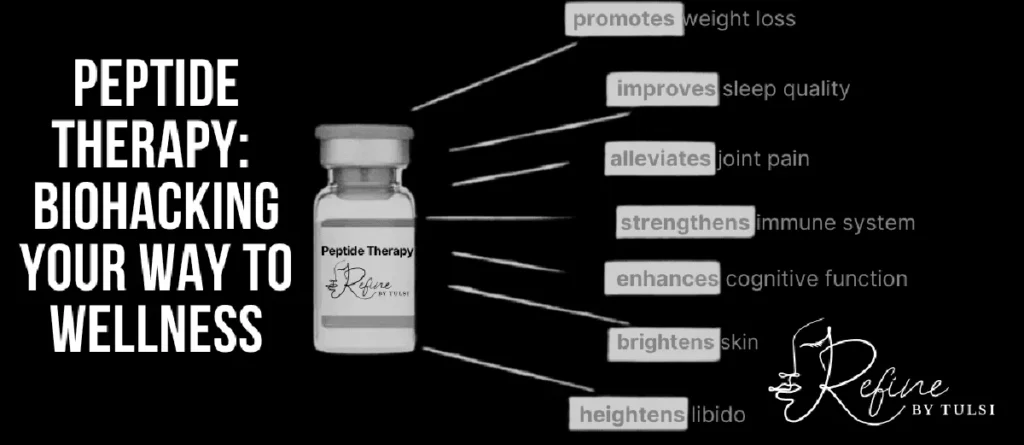
Peptides have become one of the most promising tools for 40-something joint pain. Here is what the research shows about four of them:
BPC-157: The Healing Accelerator
BPC-157 (Body Protective Compound-157) is a peptide derived from a protein in gastric juice. Research has shown it accelerates tendon, ligament, muscle, and bone repair while reducing inflammation.
It works on multiple levels: it promotes new blood vessel formation in injured tissue, dampens pro-inflammatory cytokines, repairs the gut lining (which reduces the inflammatory molecules leaking into your bloodstream), and may support cartilage preservation that slows degenerative changes.
Most people notice reduced pain and improved recovery within 2–4 weeks. Protocol length is typically 2–3 months. It comes as an oral capsule or subcutaneous injection.
TB-500: The Tissue Rebuilder
Thymosin Beta-4, known as TB-500, promotes tissue repair through different mechanisms than BPC-157 — which makes them powerful when used together. It activates cell migration to injury sites, reduces scar tissue formation, and supports tissue flexibility by regulating actin, a structural protein.
CJC-1295/Ipamorelin: The Recovery Restorer
These growth hormone secretagogues do not target joints directly. Instead, they restore the GH production that makes your entire repair system function. Higher GH levels mean faster workout recovery, better collagen production, improved sleep quality (when most repair happens), and maintained lean muscle mass.
GHK-Cu: The Collagen Rebuilder
This copper peptide stimulates collagen I, III, and V — the structural proteins that make up cartilage, tendons, ligaments, and skin. For anyone whose joint pain is driven by collagen degradation (which it almost always is by 40), GHK-Cu supports joints, skin, and connective tissue at the same time.
The Power Stack: The most popular protocol combines BPC-157 for direct tissue healing and gut repair, TB-500 for regeneration, and CJC/Ipamorelin for growth hormone optimization. Layered with hormone support and IV therapy, it addresses joint pain at every biological level.
The Complete Approach: Beyond Peptides
Peptides are the targeted intervention, but lasting results usually come from a broader protocol:
- Hormone optimization — testosterone supports muscle mass and bone density. Thyroid optimization ensures metabolic repair processes function properly. For women, estrogen replacement supports connective tissue health.
- IV nutrient therapy — magnesium for muscle relaxation and inflammation reduction, vitamin D for bone density, glutathione as a systemic antioxidant, and B vitamins for cellular energy.
- NAD+ therapy — restores the cellular energy that enables tissue repair.
- Medical weight management — if excess weight adds joint stress, GLP-1 therapy can reduce load while preserving lean muscle when combined with peptides.
What Real People Are Experiencing
One runner in her 40s told me her knees started aching after every long run — deep persistent pain and three-day recovery times. Her doctor said take ibuprofen and run less. After BPC-157, testosterone optimization, and IV magnesium, her knee pain improved by 80 percent within six weeks and her recovery time was cut in half.
A CrossFit enthusiast had nagging shoulder pain for two years. MRI showed mild tendinopathy but nothing requiring surgery. BPC-157 plus TB-500 together — by week three the shoulder felt different, less inflamed and more stable. By month two, overhead pressing was pain-free again.
And a 48-year-old who woke up every morning feeling stiff all over: after labs revealed off hormones and gut health markers, a combined protocol of peptides, growth hormone support, and monthly IV therapy had the stiffness gone in three months. “I feel like I am 38 again,” she said.
Frequently Asked Questions
Is this only for athletes?
No. Joint protocols serve everyone from marathon runners to desk workers whose backs and knees ache from sitting all day. The biological processes — inflammation, GH decline, collagen loss — affect everyone. Athletes just notice sooner because they push their bodies harder.
Can peptides replace surgery for joint issues?
For structural damage like torn ligaments or severe cartilage loss, surgery may still be necessary. But for most 40-something joint pain — tendinopathy, chronic inflammation, slow recovery, stiffness — peptides address the biological root causes that surgery does not. Many people who were considering surgery find peptide therapy resolves or significantly reduces their symptoms.
How long does a protocol take?
Most people notice improvement within 2–4 weeks. Optimal results typically arrive at 8–12 weeks. The initial peptide course runs 2–4 months, with ongoing hormone optimization and nutrient support as maintenance.
How much does it cost?
Peptide protocols typically range from $300–$600 per month. IV therapy sessions run $200–$400 each. Hormone optimization is additional, though many programs bundle these at preferred pricing.
The Bottom Line
Joint pain in your 40s is not inevitable. It is the result of declining growth hormone, rising inflammation, weakening collagen, and hormonal shifts — all measurable, all treatable. BPC-157 and TB-500 target tissue healing directly. CJC/Ipamorelin restores the GH your recovery depends on. Hormone optimization addresses the foundation.
“Just getting older” is a diagnosis of resignation. The biology behind 40-something joint pain is treatable — and you do not have to accept stiffness as your new normal.
The Glow Ritual
This week, try this: after your morning shower, while your skin is still damp, spend two minutes massaging your knees or shoulders with a warm hand. Think of it like watering a houseplant — small, daily attention makes the difference. Your joints will thank you.
A note from Johnson: I used to think my aching knees meant I had to slow down permanently. Turns out they just needed me to pay attention differently. A little glow applies to your whole body, not just your face.