
Most mornings I’m already at the sink before the coffee kicks in. Cleanser, moisturizer, sunscreen — five minutes, same order, no drama. Friends call it a ritual. I call it the thing that actually works. And lately I’ve been thinking about how much the Battle of Zama, a fight that ended over two thousand years ago, is about exactly this.
The General Who Won and Still Lost
Here’s the story in one breath. For over 15 years, the Carthaginian commander Hannibal terrorized Rome — destroying entire armies and pushing the republic to the edge. He won battle after battle. And he still lost the war.
The ending was decided by a young Roman named Publius Cornelius Scipio, who figured out something most of us are too busy to notice: you can’t win a war by always fighting where the enemy is comfortable. You win it by changing the game.
A Very Quick Recap (Because Context Matters)
Rome and Carthage were the two big powers of the western Mediterranean in the third century BC. Rome controlled most of Italy. Carthage — near modern Tunis, in present-day Tunisia — was a wealthy maritime empire with territory across North Africa, Sicily, Sardinia, and southern Spain.
They’d lived under treaties for a while. Then Rome started moving south, and the First Punic War kicked off in 264 BC over Sicily. It lasted 23 years, mostly at sea, and Rome barely won it.
The Second Punic War began in 219 BC when Hannibal attacked Saguntum, a coastal city in Iberia that had diplomatic ties with Rome. Legend has it his father made him swear as a child that he’d never be a friend of Rome. He meant it.
How Hannibal Broke Rome
Hannibal marched into Italy with war elephants and a campaign the Romans had never seen. At the Battle of the Trebia in December 218 BC, he used deception and a hidden force to cut down a Roman army in northern Italy. About 20,000 Romans were killed. At Lake Trasimene in 217 BC, he pulled off one of the largest ambushes in military history — as many as 15,000 Romans dead.
Rome appointed Quintus Fabius as dictator, and his answer was the most counterintuitive thing a general can do: don’t fight. He shadowed Hannibal, avoided direct contact, and let Rome lick its wounds. The Romans hated it, but it worked. When they finally tried to fight head-on in 216 BC at Cannae, they lost 50,000 to 70,000 men in a single day. That’s about the number of Americans who died in a single day of the Vietnam War. Rome nearly collapsed.
Hannibal could have marched on the capital. He didn’t. He sat in Italy and waited. And for a while, that was enough to keep Rome off balance.
The Strategy That Actually Ended It
The man who fixed the problem was Scipio. He came from one of Rome’s leading families — his father and uncle had both died commanding forces in Iberia in 211 BC. In 210 BC, Rome gave him command in Spain at a young age, and he showed what he was made of.
In 209 BC he captured Carthago Nova, Carthage’s main military and administrative base in Iberia. He won at Baecula in 208 BC and at Ilipa in 206 BC, where he used an unusual deployment and unexpected shifts in formation to break a Carthaginian army. By the end of 206 BC, Carthaginian power in Iberia had effectively collapsed.
He didn’t fight Hannibal directly — Hannibal was still in Italy — but he’d bled the enemy enough. Then he proposed the bold move: stop fighting in Italy, and invade North Africa instead. If Carthage itself was threatened, Hannibal would have to come home.
It worked. Scipio landed near Utica in 204 BC, and Carthage was suddenly fighting on its own soil. He also did something smart: he allied with Masinissa, a Numidian prince, and leaned on the Numidians’ cavalry, which was fast, mobile, and lethal in open terrain. In 203 BC he hit Carthaginian camps in a nighttime surprise attack, won at the Battle of the Great Plains, and captured Syphax, Masinissa’s rival who had been backing Carthage.
Carthage called Hannibal home. He’d been in Italy about 15 years. His brother Hasdrubal had tried to bring reinforcements across from Iberia in 207 BC and was killed at the Battle of the Metaurus. Reinforcements had been getting harder and harder. He sailed back with the veterans who were still with him.
The Meeting That Almost Ended It
Before the final battle, the two generals met in person to negotiate. It’s one of the most famous conversations in military history. Hannibal reminded Scipio that war is unpredictable, pointed to his own record of brilliant wins that hadn’t produced a political result, and offered a settlement: Rome keeps the overseas territories, Carthage stays safe in Africa.
Scipio said no. He said Carthage had already broken preliminary terms. They parted without a deal.
The Battle of Zama, 202 BC
The exact date is debated — many accounts say October 19, autumn. The exact location is disputed too. The name comes from a town near Hannibal’s movements before the battle, but the armies didn’t actually fight there.
Scipio had 23,000 to 30,000 infantry and 6,000 to 7,000 cavalry. Hannibal had 36,000 to 40,000 infantry, 2,000 to 4,000 cavalry, and about 80 war elephants.
Hannibal set his army in three lines. The front line was mercenaries and allied troops. The middle was Carthaginian and African troops raised to defend the homeland. The back line was his veterans — the men who’d survived years of fighting Rome, personally loyal to him.
Scipio did something clever with his own formation. Instead of stacking units so the back line covered the front line’s gaps, he lined his units up so the gaps between them created open corridors through his whole army.
The battle opened with cavalry skirmishes. Then Hannibal sent the elephants forward.
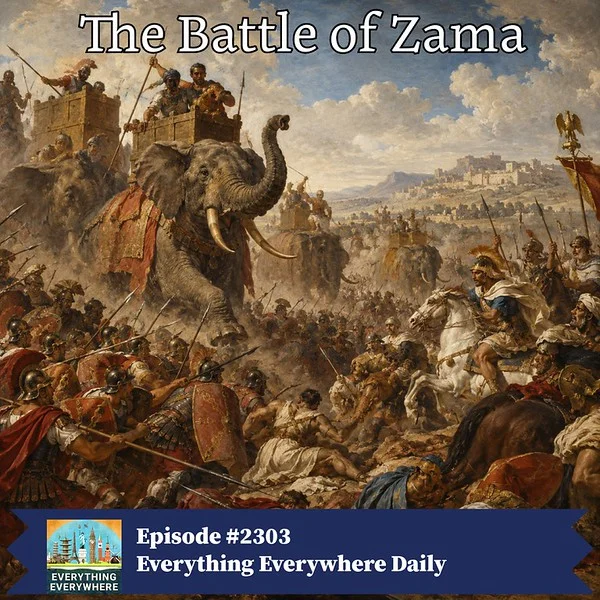
Elephants were terrifying, but they were also skittish. Loud noise, strange movement, or a wound could send them running. Scipio had prepared for exactly this. His skirmishers hit the elephants with javelins, and Roman soldiers blew trumpets and horns to add to the chaos. Some elephants panicked and turned back toward their own lines. According to the ancient historian Polybius, several crashed into Hannibal’s own cavalry on his left flank. The ones that kept going ran straight into the Roman corridors, where they were picked off from the sides or driven off.
Meanwhile, the Roman and Numidian cavalry broke the Carthaginian horsemen and chased them off the field. Roman infantry pushed back Hannibal’s first two lines and then met his veterans, who fought hard. The battle stayed tight until the cavalry came back around and hit the Carthaginian infantry from behind — trapping them between the legions in front and the horsemen behind. The army collapsed. Hannibal escaped.
What Came After
Zama ended the Second Punic War. Rome was now the dominant power in the western Mediterranean. Scipio came home a national hero, celebrated a triumph, and got the name Africanus — a permanent reminder of where he’d won.
Hannibal was exiled. He spent his remaining years consulting with Rome’s enemies, but the damage was done. Carthage wasn’t destroyed right away — it stayed alive for another 50 years, heavily in debt to Rome, with its military size capped — until the Third Punic War finally ended it.
What This Has to Do with Your Skin (And Your Life)
I’m not a historian, and I’m not pretending this is a skincare article. But here’s what I keep coming back to: Hannibal won more spectacular battles than Scipio ever did. He had the better army, the scarier elephants, the more creative tactics. And he lost, because his wins never forced a single decisive moment.
Scipio didn’t win by out-muscling Hannibal. He won by staying consistent long enough to change the shape of the war. He captured a base. He won a battle. He won another. He built an alliance. He made a bold move. Each one was boring in isolation. Together, they ended the war.
That’s how the good routines work. Not one dramatic transformation. Not a miracle serum you use once and feel reborn. A small, repeatable action, done enough times that it changes the shape of your week.
The Glow Ritual
This week, pick one tiny thing you’ve been skipping — the 30-second neck pass, the eye cream you keep meaning to buy, the 5-minute Sunday reset. Do it the same way, in the same order, every day for 14 days. Don’t add anything else. Don’t measure it. Just do it. By the end of two weeks it won’t feel like a task anymore. It’ll just be part of the morning, the way Rome’s legions stopped feeling like a punishment and started feeling like the point.
Is the Battle of Zama really relevant to a skincare blog?
More than you’d think. The point isn’t the elephants. It’s that consistent, small, boring actions beat dramatic, one-off wins. That’s the whole argument for a daily routine over a once-a-month “treat yourself” splurge.
Do I need to know more about the Second Punic War before reading this?
No. I kept the recap short on purpose. If you want more, the ancient historian Polybius wrote the primary account, and there’s a lot of good modern coverage of the war. This piece is about the lesson, not the lore.
So what’s the actual lesson for my daily routine?
Win the war, not the battle. One dramatic product change won’t fix your skin. A small, repeatable ritual done consistently for weeks will. Hannibal had the better battles. Scipio had the better war.
A note from Johnson: I read this story on a Tuesday night when my skin was doing its best “I give up” impression. I was ready to throw out my entire routine and buy something new. Instead, I did the boring thing: same cleanser, same moisturizer, same sunscreen, same order. Two weeks later the irritation was gone. I don’t know if that was the routine or just time. I’m pretty sure it was the routine. Glow is a habit, not a product.
1 Comment